

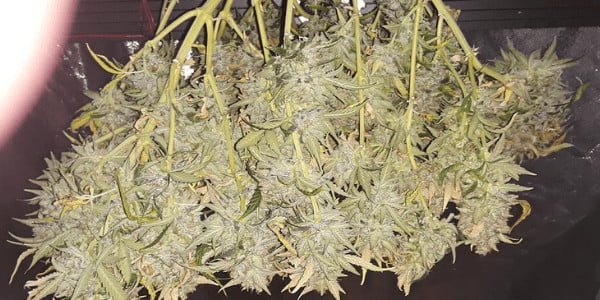
Rushed drying destroys what months of careful growing built. Research published in Cannabis Business Times (2025 drying update) found that a bud dried in 4 days smells flat compared to the same genetics dried in 10 days – and no curing technique recovers what fast drying loses. The two weeks after harvest are where 10–20% of your crop’s value can quietly disappear.
After 14 harvests this year alone, here’s the exact process I use.
- The 60/60 rule: 60°F temperature at 60% relative humidity is the current industry standard for drying
- Monoterpenes lose ~55% in the first week of room-temperature drying above 68°F (PMC/NCBI, 2024)
- Minimum drying time is 10 days — never jar buds with stems that still bend rather than snap
- Curing requires 4 weeks minimum; 6–8 weeks produces measurably better smoothness and flavor
- Boveda 62% humidity packs in glass jars eliminate most curing problems for beginners
What Actually Happens When You Dry Cannabis?
Fresh-cut cannabis contains approximately 80% moisture by weight. The drying process drops this to 10–12%, preparing the flower for enzymatic curing in jars (Cannabis Science and Technology). This isn’t just evaporation — it’s a carefully paced biochemical process.
Chlorophyll breaks down as moisture leaves. Residual sugars and starches metabolize. The harsh, green “hay” smell of freshly cut cannabis transitions into the strain-specific terpene profile you worked to grow. Rush this process and the chlorophyll doesn’t break down completely, and the harsh taste is locked in permanently.
Peer-reviewed research in PMC/NCBI (Cultivar-Specific Drying Approaches for Medicinal Cannabis) found that monoterpenes decrease by approximately 55% in the first week of room-temperature drying when temperatures exceed 68°F.
How Do You Set Up the Ideal Drying Space?
The drying environment has four controllable variables. Getting all four right means the difference between good flower and great flower.
Temperature: 60–65°F (15–18°C)
This is the single most impactful variable. At 60°F, the slowest monoterpene evaporation rate occurs. At 70°F, you’ve already lost roughly 45% of your most volatile terpenes after 7 days. At 75°F, you’re down to 28% retention.
A small portable AC unit ($100–$150) running in a closet or drying tent with an Inkbird ITC-308 controller set to 62°F runs precisely without constant monitoring.
Humidity: 58–62% RH
This prevents mold (above 65% is risk territory) while slowing moisture loss enough to allow proper chlorophyll breakdown. A digital hygrometer ($8–$15) placed in the drying space is non-negotiable.
If humidity drops below 55%, add a bowl of water or reduce airflow. If it climbs above 65%, increase airflow or run a small dehumidifier.
Darkness: Complete
UV light breaks down THC into CBN at a meaningful rate. A hang-dry space with no windows, or windows covered, is ideal. If you’re using a tent, keep it zipped except for check-ins.
Airflow: Gentle and Indirect
Air should circulate through the space — never blow directly across the buds. A small clip-on fan oscillating on the lowest setting, aimed at a wall rather than at the plants, creates enough circulation to prevent stagnant pockets (mold risk) without stripping surface moisture too quickly.
Redd’s setup: A 4×2 grow tent as a dedicated drying space, small portable AC, Inkbird controller, one small oscillating fan aimed at the tent wall. This runs any harvest at exactly 62°F / 60% RH with no intervention. Total equipment cost: under $200.
How Long Should You Dry Cannabis?
The minimum is 10 days. The target is 10–14 days. There is no shortcut.
The classic readiness test: smaller branches (pencil-thickness and under) should snap cleanly when bent. Larger stems will still bend — that’s normal. The buds themselves should feel slightly crispy on the exterior but still have internal give when gently squeezed.
The water activity target for jarring is 0.60–0.65. Home growers use the stem snap test combined with a feel test — both methods work.
How Do You Cure Cannabis in Jars?
Curing is where the finished product separates from mediocre product. It’s an enzymatic and chemical process — chlorophyll continues breaking down, residual sugars metabolize, and the terpene profile develops complexity that just-dried flower doesn’t have.
Step 1: Trim and Jar
Trim any remaining sugar leaves (if dry trimming) and place buds loosely in wide-mouth mason jars. Fill jars to 75% capacity — you need headspace for air exchange. Add a Boveda 62% humidity pack (Size 8 for a 32 oz / 1-quart jar).
Step 2: Burp Daily for 2 Weeks
Open each jar once per day for 5–10 minutes. This releases built-up CO₂ and replenishes oxygen, which is necessary for the enzymatic process. If you open a jar and smell ammonia, the buds are too wet — spread them on a paper bag for 2–4 hours before re-jarring.
Step 3: Reduce Burping to Every Other Day (Weeks 3–4)
By week 3, the active chemical processes are slowing. Burp every other day, or every 3 days if humidity is staying stable.
Step 4: Weekly Burping (Weeks 5–8)
By week 5, burp once weekly. The cure is largely complete by week 6–8 for most strains.
Step 5: Long-term Storage
After 8 weeks, switch humidity packs to 58% if smoking within 3 months, or maintain 62% for longer storage. Keep jars in a dark, temperature-stable environment.
Honest observation: The flavor improvement between week 2 and week 6 of curing is not subtle — it’s the difference between “fine” and “this is why I grow my own.” If you’ve never let a cure go past 3 weeks, you haven’t actually tasted what your strain produces.
What Humidity Pack Should You Use?
Boveda and Integra Boost perform equally in side-by-side tests (GrowWeedEasy, 2026). The choice between them is preference, not performance.
| Humidity % | Best For | Notes |
|---|---|---|
| 58% RH | Smoking within 1–3 months | Slightly drier, longer shelf stability |
| 62% RH | Active curing + medium-term storage | Optimal for enzymatic activity |
Size guide: Size 8 Boveda (8-gram pack) is correct for a 1-quart mason jar with 1 oz of flower. Half-gallon jars need two Size 8 packs. Replace packs when they become rigid — a soft, pliable pack is still active.
How Do You Troubleshoot Common Drying and Curing Problems?
Cause: Buds were jarred too wet. Bacteria are metabolizing. Fix: Remove buds, spread on paper bags at 60°F / 50% RH for 2–4 hours until the ammonia smell dissipates, then re-jar.
Cause: Dried too fast (above 70°F) or dried in bright light. Fix: Slow curing at 62% RH for 6–8 weeks will improve but not fully recover this. Prevention is the only real solution.
Cause: Jarred too wet, temperature too high, or packs not sealing. Fix: Discard moldy buds immediately. Do not attempt to “save” moldy cannabis.
Cause: Humidity packs depleted or jars not sealing properly. Fix: Replace humidity packs with fresh 62% packs. Check jar seals.
Frequently Asked Questions
Can I speed up the drying process without losing quality?
No reliable method speeds up drying without quality loss. Controlled atmosphere drying chambers cut time by up to 60% (PMC/NCBI, 2024), but cost $500–$2,000 and are designed for commercial growers. For home grows, the 10–14 day window at proper conditions is the standard.
Is it OK to dry cannabis in the same room as the grow?
Only if your grow tent maintains 60–65°F and 58–62% RH during drying — unlikely since growing environments run warmer. A separate, temperature-controlled drying space almost always produces better results.
How do I know when curing is complete?
There’s no hard stop for curing — it’s a spectrum of quality. 4 weeks is the minimum for meaningful improvement. 6 weeks produces noticeably better flavor. 8 weeks is where most high-end results begin. You can smoke at any point; you’re just deciding how refined the final product will be.
Does the strain affect how long I should dry and cure?
Yes. Dense, thick-caloxed indica buds dry slower and often benefit from the full 14 days or slightly more. Airy sativa buds can be ready at 10 days. Always use the stem snap test rather than the calendar.
