
Cannabis Nutrient Deficiencies: Complete Guide [Visual Charts]
Byredd
If you’re looking for answers about cannabis nutrient deficiencies, you’re in the right spot.
I love growing cannabis and learning more about it. Dealing with nutrient deficiencies can be tough.
In this blog post, I aim to help you understand why and how to fix nutrient deficiencies in your plants. We’ll cover the basics and offer simple solutions.
We’ll explore:
- The importance of knowing what your cannabis plants need
- The different kinds of nutrient deficiencies
- How to spot and solve these problems
By the time you finish reading, you’ll know how to handle nutrient deficiencies. Your plants will stay healthy and strong.
Every grower wants to grow the best cannabis. Since every grow room is different, focus on what you can control and understand.
Your plants need the right temperature and humidity. They also need enough light, good airflow, and the right food. This food should have all the nutrients they need at the right pH.
If your plant is missing one of these things, it will get stressed. This stress makes it weak to diseases, mold, pests, and other issues. It will grow poorly and produce less.
Knowing how to fix nutrient problems is key to growing healthy plants. This article will teach you about common nutrient deficiencies in cannabis and how to fix them. You’ll also learn how to prevent these problems.
Growing autoflowers? Best Autoflower Feeding Schedules
What are cannabis plant nutrient deficiencies?
A cannabis deficiency happens when a plant can’t get a key nutrient or mineral. Even with a good diet, missing one nutrient can harm growth. It can lower yield and quality, or even kill the plant.
Luckily, cannabis plants can show us when they’re not getting what they need. If we know what to look for, we can see signs in the leaves and plant appearance. Keep reading to learn more.
Nutrients and pH levels for cannabis
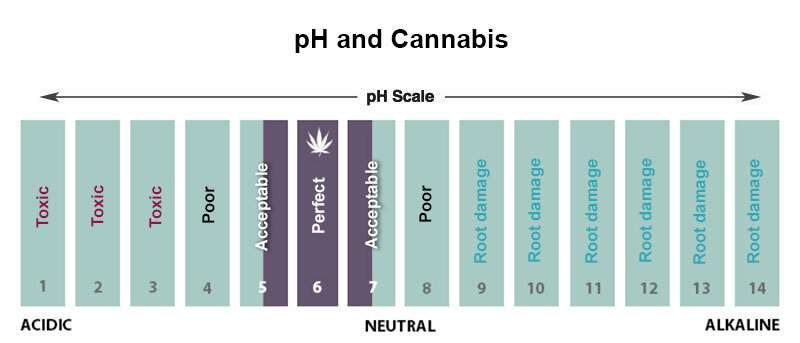
One of the surprising things about growing cannabis is that plants can still have nutrient deficiencies. Even if you give them a balanced diet, they might not absorb it well. This is because the pH level of the soil is key for nutrient absorption.
If the soil is too acidic or too alkaline, nutrients can’t get to the roots. This makes it hard for plants to get what they need.
Before you can spot any nutrient problems, check the pH level first. For plants in soil, aim for a pH of 5.8-6.8. The ideal spot is around pH 6.3.
Soil and similar mediums usually have the right pH naturally. But it’s good to double-check. Hydroponic growers should follow the pH advice from their nutrient suppliers. A pH of about 6 is common.
It’s smart to know the natural pH of your local water. The pH of your water can change. It might go up or down with the seasons and water treatment.
Knowing the pH of your water is a good first step. It’s something to keep an eye on.
Cannabis deficiencies and water supply
Some local water sources can have naturally high levels of some minerals but may be low in others. This can make it tricky to use certain nutrient additives if you already have variable levels in your water supply.
That’s why some professional growers try to take the variables within the natural water supply out of the equation and use deionized water. This is water that has been specially filtered to remove any mineral ions. The result is pure water that is free from any mineral content. Some growers prefer to use fully deionized water as the starting point. However, this approach tends to be used by a small minority of serious growers. Most cannabis home growers tend to use tap water and find it generally works well enough.
Cannabis nutrient deficiencies: macronutrients and micronutrients
Macronutrients are needed in big amounts by your cannabis plants. The main ones are Nitrogen, Potassium, and Phosphorus. They help with growth and bloom.
Micronutrients are needed in small amounts. They help with plant health. Examples include Copper, Silicon, and Zinc.
Mobile nutrients vs. immobile nutrients in cannabis deficiencies
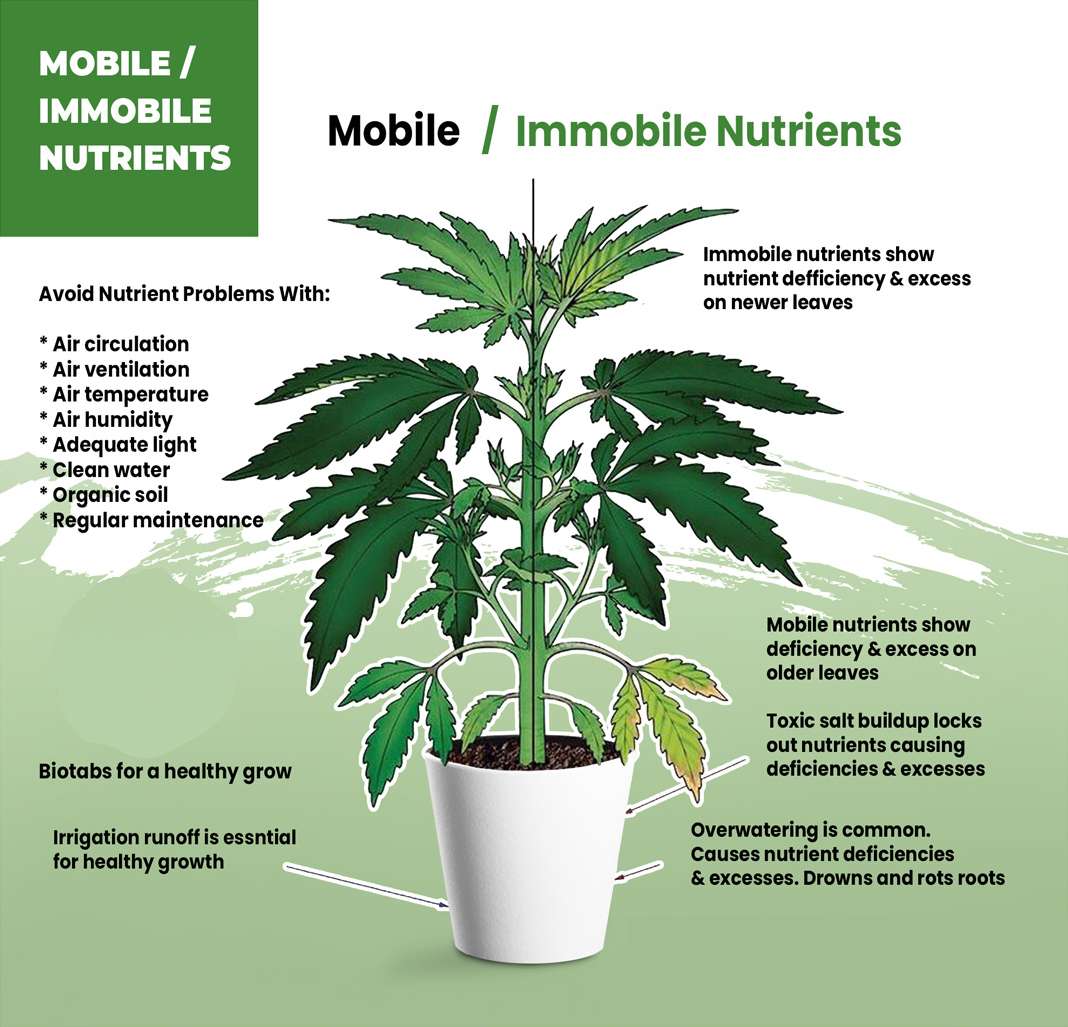
Knowing the difference between mobile and immobile nutrients is key. Mobile nutrients like Phosphorus can move around in the plant. If it’s stored in an old fan leaf, you’ll see the problem there first.
Minerals like Zinc are hard to move once they’re placed. So, you might see problems in new growth first.
Cannabis Nutrient Deficiencies and Excesses Chart
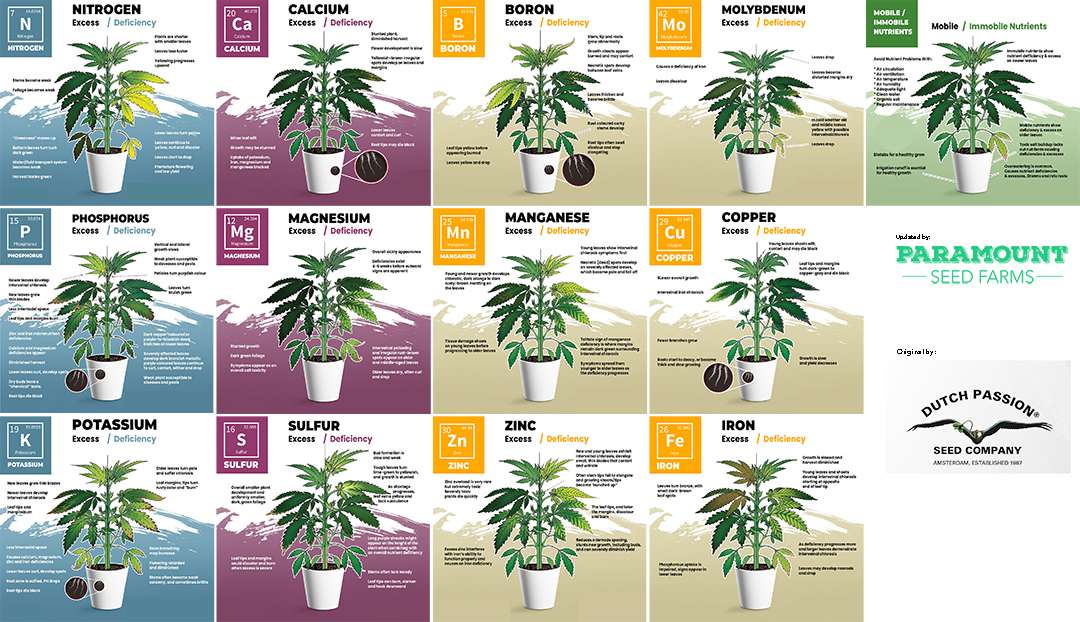
Cannabis Deficiency Chart – Cannabis Leaf Deficiency Chart – Cannabis Nutrient Deficiency Chart – Weed Deficiencies Chart – Marijuana Deficiency Chart – The images and information in this post are partly based on content from Jorge Cervantes. All rights reserved. Visit marijuanagrowing.com for more information.
Preventing problems is always better than fixing them. Mineral deficiencies can be tricky to spot and fix. They can look similar, making it hard to know what to do.
Soil growers can avoid these issues by using big containers of good soil. High-quality soil means plants have more nutrients. This helps prevent deficiencies.
Plants can face many problems, especially in bad soil. If the soil’s pH is wrong, nutrients can’t be used. This is called ‘nutrient lockout’.
How to identify and treat plant nutrient deficiency
If your plant is sick, act fast. Deficiencies can ruin your harvest. In the worst case, your plant might not make it.
A healthy plant can fight off pests and diseases better. But a sick plant is more vulnerable. Good nutrition is key to keeping your plant strong.
Nitrogen deficiency in cannabis
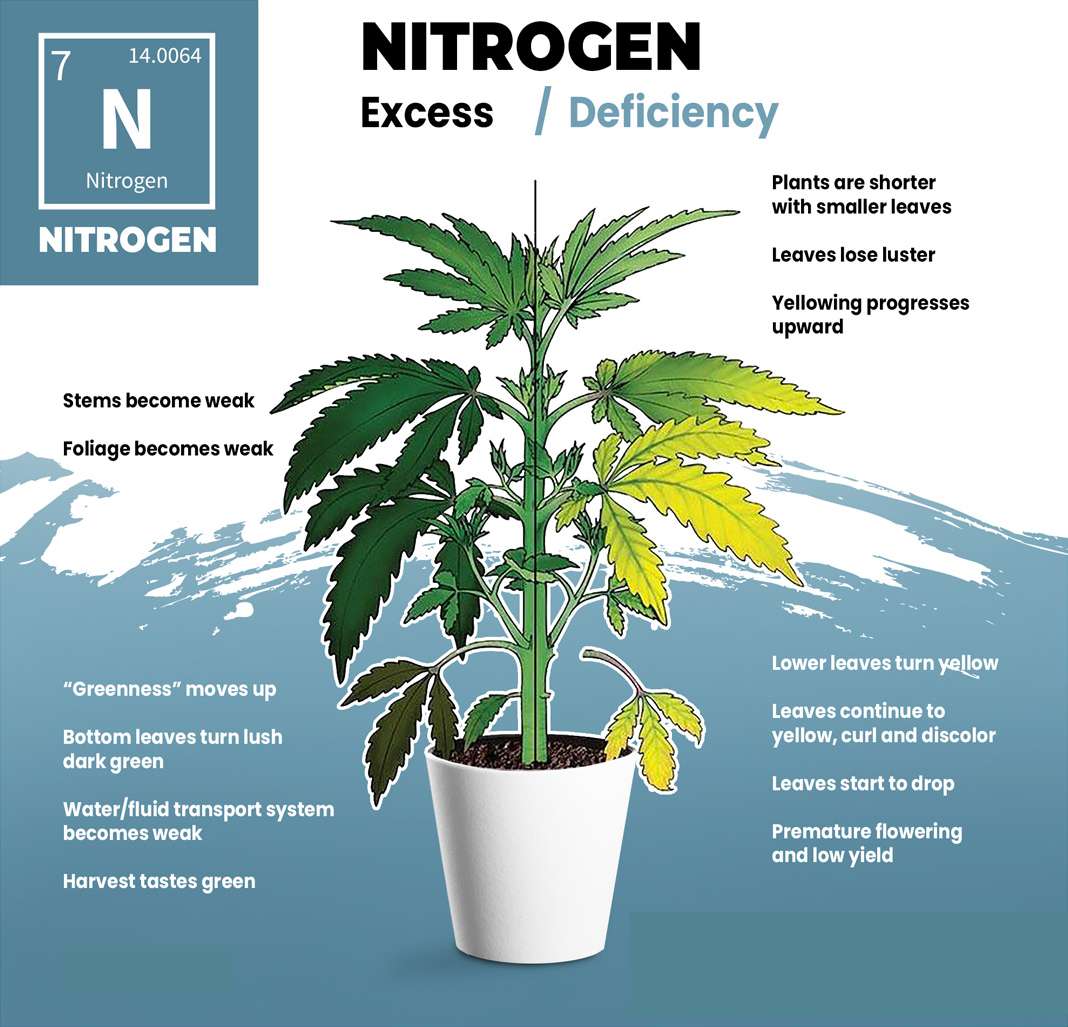
Nitrogen (chemical symbol ‘N’) is regarded as a mobile macronutrient. Not only is Nitrogen an essential part of plant proteins, but it is also vital for the healthy functioning of photosynthesis, especially in vegetative growth.
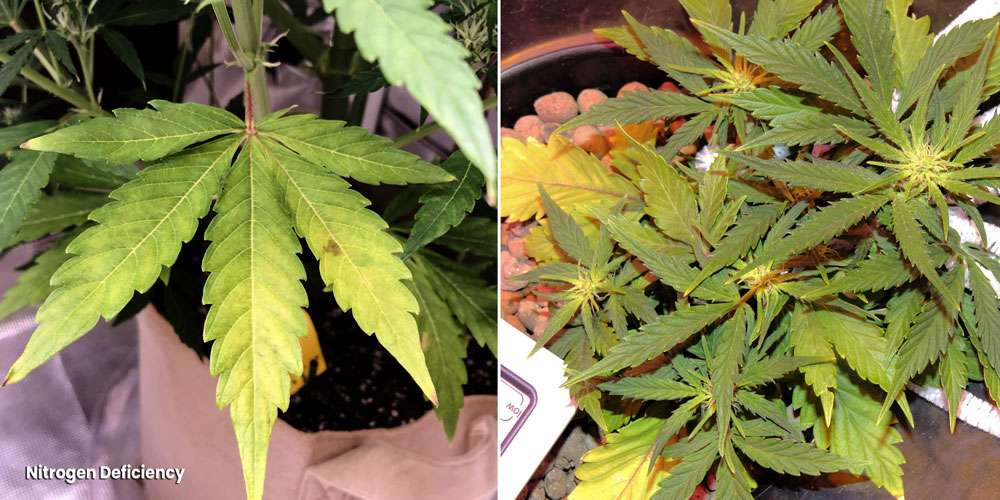
Symptoms
Nitrogen deficiency makes leaves pale and yellow. They may curl and fall off. Leaves at the base turn yellow first.
Nitrogen toxicity
Too much Nitrogen makes leaves look too dark. You can fix this by using less nutrients or flushing the plant.
How to treat Nitrogen deficiency in cannabis
Standard nutrients often have a lot of Nitrogen. They can help quickly. Make sure your nutrient pH is right.
Try a foliar feed spray with seaweed or fish-based nutrients. This way, leaves can soak up nutrients directly.
Phosphorus deficiency in cannabis
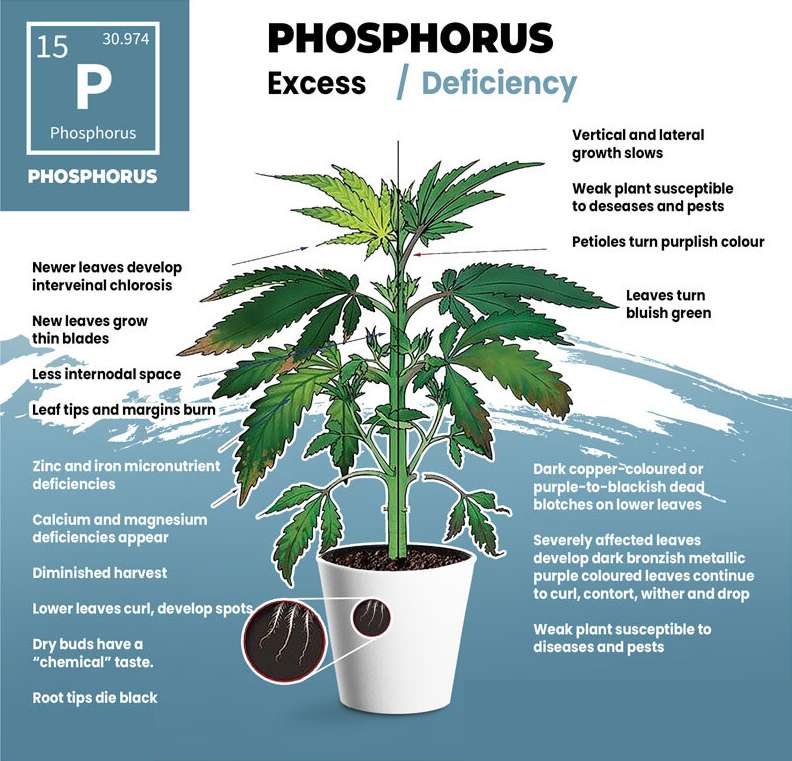
Just like Nitrogen, Phosphorus (chemical Symbol ‘P’) is a mobile macronutrient that is essential to plant health and growth. It is used in the formation of plant proteins and plant DNA and is essential for proper photosynthesis to occur.
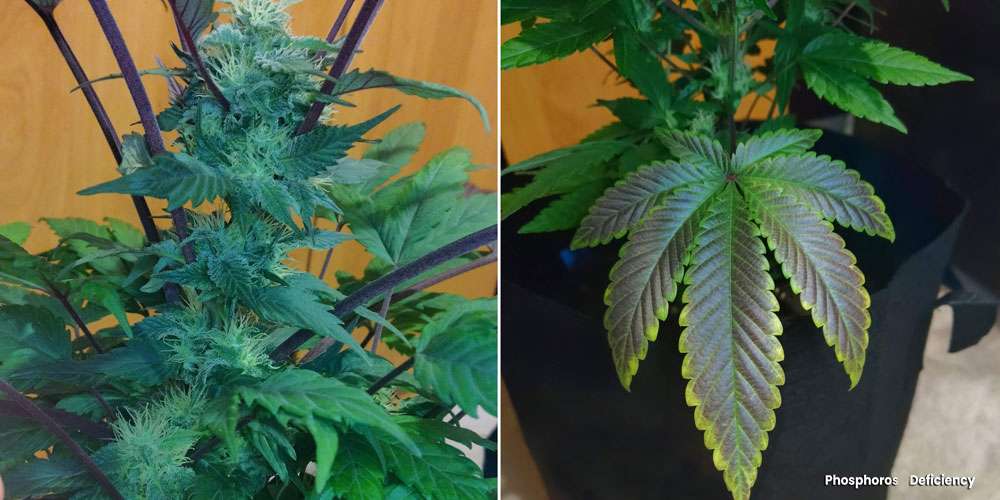
Symptoms
If you’ve seen dry leaves with brown spots, you might have seen Phosphorus deficiency. It can also cause red/purple spots in leaf stems. The leaves may turn dark blue/green. If not treated, it slows down plant growth a lot.
Dark spots can show up on leaves. Leaves might curl and fall off. They might look metallic purple or dark bronze.
How to treat it
Keep your soil’s pH acidic, closer to 6. Use a phosphorus-rich fertilizer. Fish meal or worm castings are good organic choices. Make sure your plant’s temperature is right.
Don’t overwater your plant.
How to prevent it
Use soil rich in Phosphorus. Use a well-aerated grow container for better soil. Adding well-rotted manure to your compost can help.
Beneficial mycorrhizal fungi improve soil health. They help turn phosphates into forms your plant can use better.
Potassium deficiency in cannabis
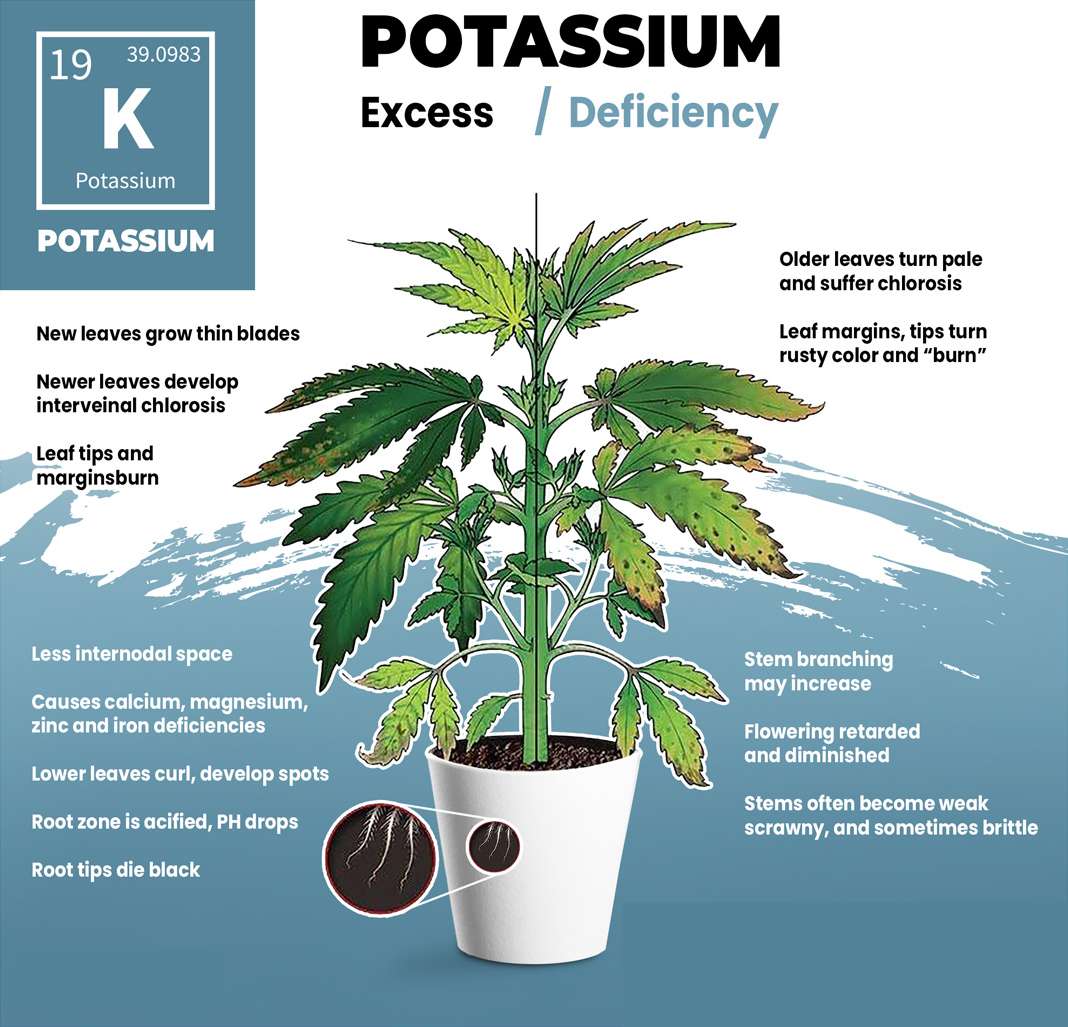
Alongside Phosphorus and Nitrogen, Potassium (chemical symbol is ‘K’) is the other main mobile macronutrient used by the cannabis plant. Potassium is vital for the synthesis and transportation of sugars and simple carbohydrates.
Potassium is also required to enable transpiration/water uptake as well as root growth and cell division. Potassium is also vital for the production of Adenosine Triphosphate (‘ATP’), which is a measure of cellular energy.
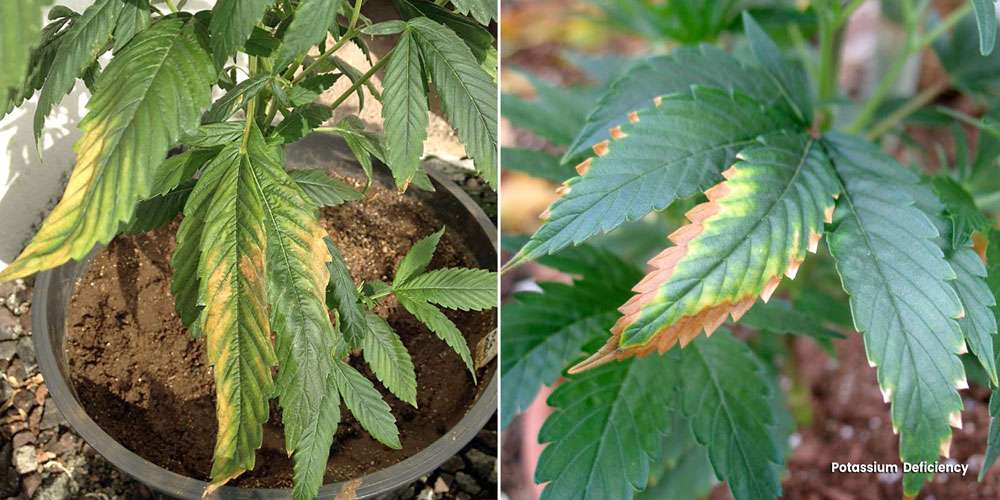
Symptoms
You may see curling leaves as well as brown and yellow colors on leaf tips and leaf edges. Your plants may stretch more than normal with a Potassium deficiency.
How to treat it
Some growers like to flush their grow medium to ensure they are not dealing with other issues, such as overfeeding, which can interfere with Potassium uptake. Chicken manure as a top dressing to your grow medium can help, as can a Potassium-rich nutrient or foliar feed. Organic seaweed is particularly useful as a foliar feed.
Magnesium deficiency in cannabis
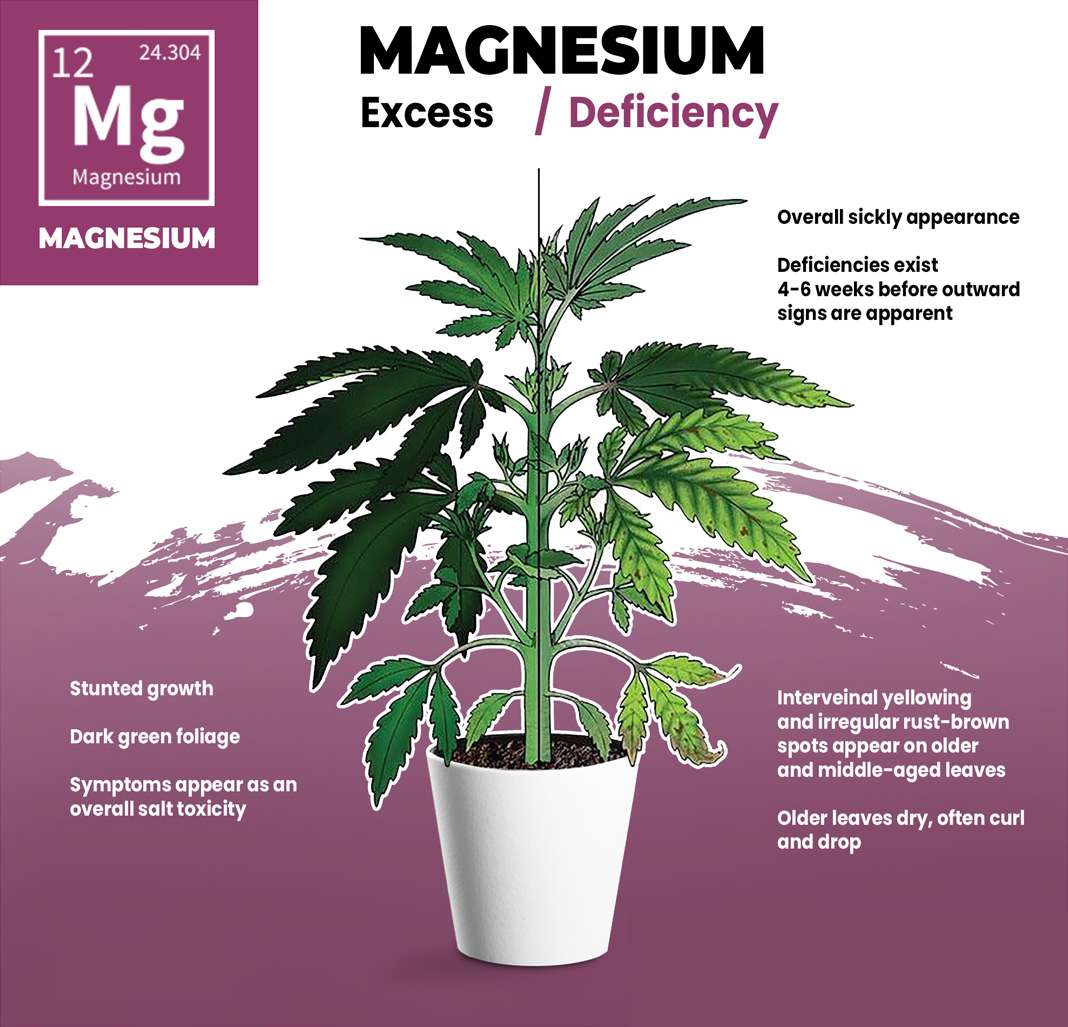
Magnesium (chemical symbol ‘Mg’) is an immobile micronutrient. It is essential for photosynthesis and makes the vital chlorophyll pigment. Without Magnesium, chlorophyll and photosynthesis can’t happen.
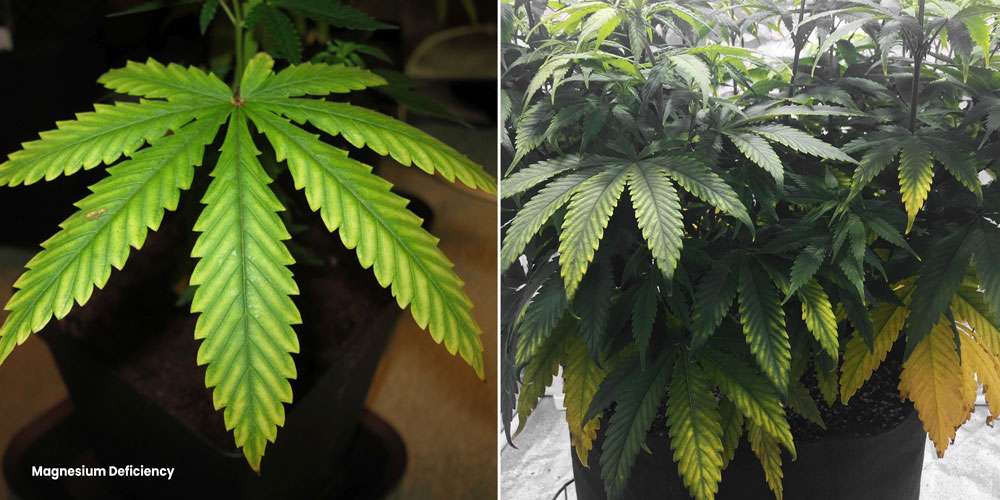
Symptoms
Any nutrient deficiency shows up in new leaves. Leaves turn yellow and then brown, dying. Older leaves turn yellow between veins and may have rust spots.
How to treat it
Fix pH by flushing with water at pH 6. Use Epsom salts to help. Add a teaspoon to a liter of water and see how plants react.
How to prevent Magnesium deficiency
Preventing is better than treating. Use quality compost and big containers for more nutrients. Add powdered dolomite limestone for Magnesium. Buy Calcium/Magnesium-rich nutrients at grow shops.
Calcium deficiency in cannabis
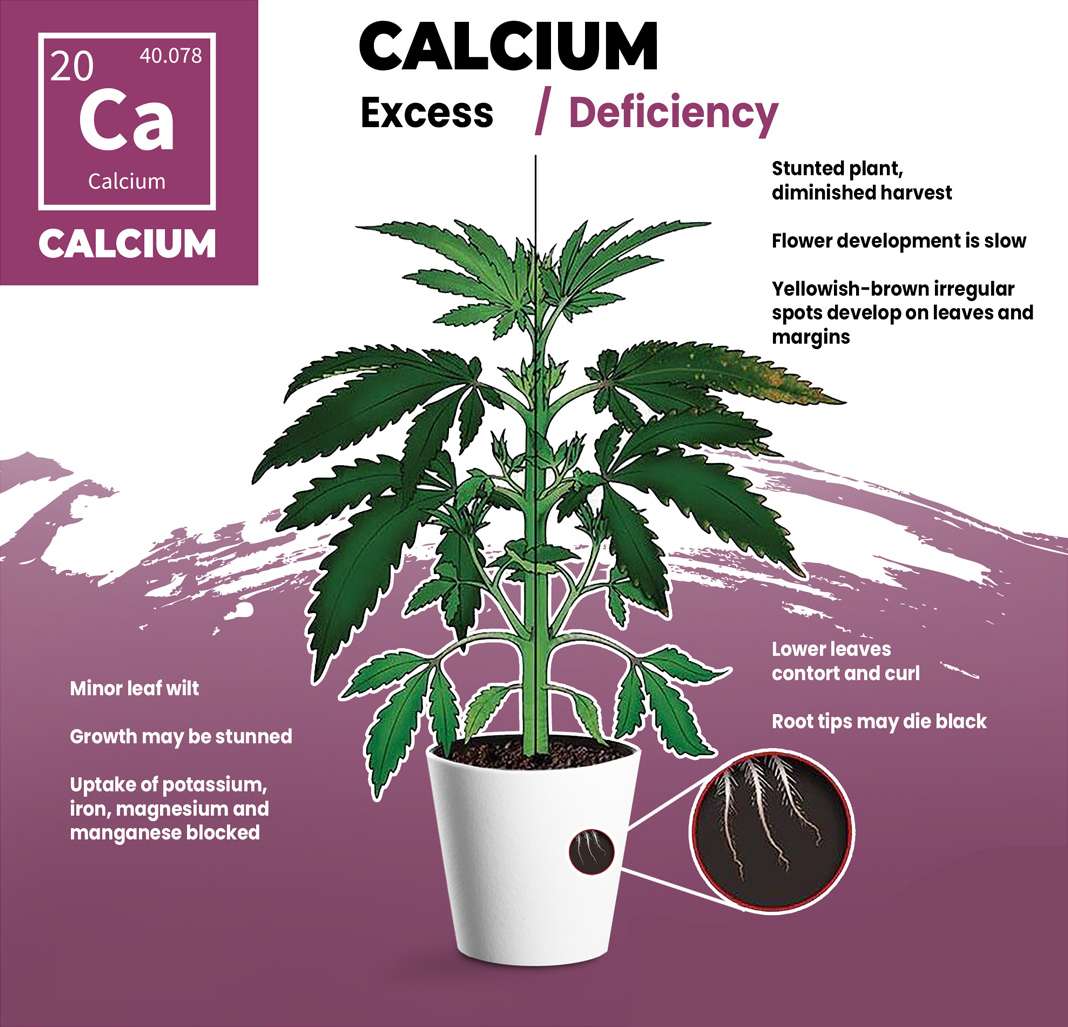
Calcium (chemical symbol ‘Ca’) is an immobile micronutrient, but one that has an essential role in the plant structure. Calcium helps fortify the cell walls. A Calcium deficiency can, therefore, result in warped structure/lack of structure to new growth. Calcium also helps the flow of Nitrogen and sugars through the plant.
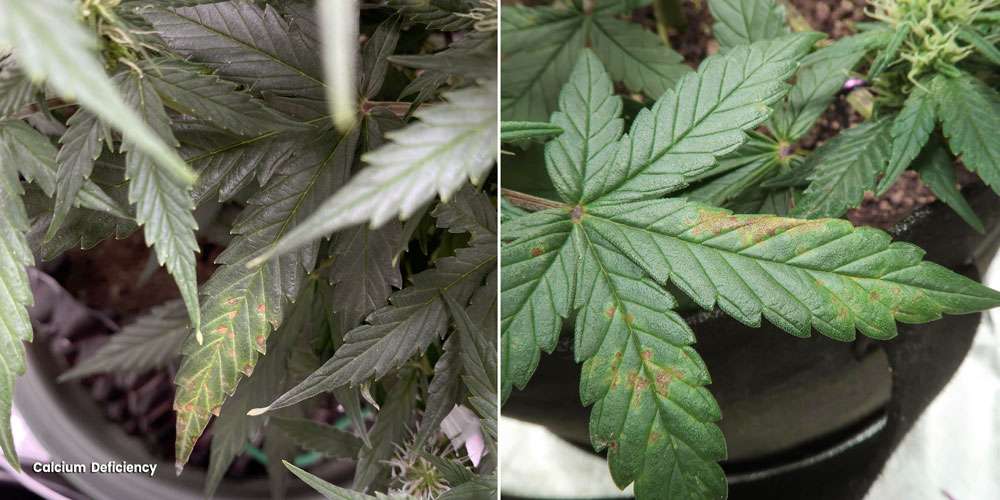
Symptoms
Leaves, especially lower ones can curl and take on unusual shapes. You may also observe yellow/brown spots. These can have brown borders and will grow over time as the problem continues. Root health is also damaged by Calcium deficiency, root tips will slowly die. The result is a stunted plant that will struggle to recover in the worst cases. Don’t confuse a Calcium deficiency with environmental issues out of range VPD.
How to treat it
A Calcium/Magnesium nutrient supplement is a fast and direct solution. Ensure your feed pH hasn’t become too alkaline and is in range. If you don’t have a Ca/Mg supplement, you can try adding a teaspoon of hydrated lime to around 4 liters of water and using this as a feed. A good way to prevent Calcium deficiency (prevention is always better than cure) is to add powdered dolomite lime to your grow medium.
Boron deficiency in cannabis
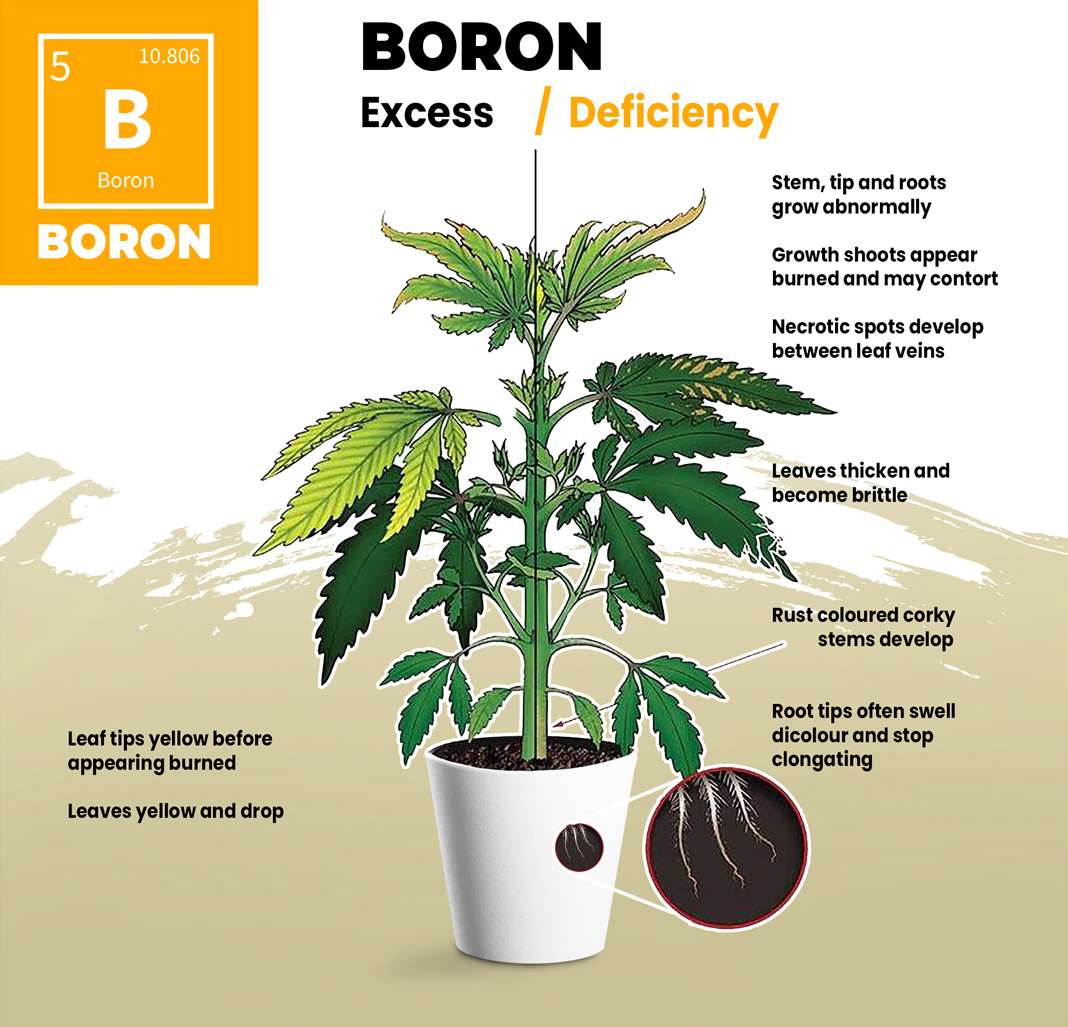
Boron (chemical symbol ‘B’) is used together with Calcium to ensure healthy cell walls and effective cell division. Boron is an immobile macronutrient. It is required in small amounts, so it is one of the less common cannabis nutrient deficiencies to see. Most good quality soils/compost contain sufficient Boron.
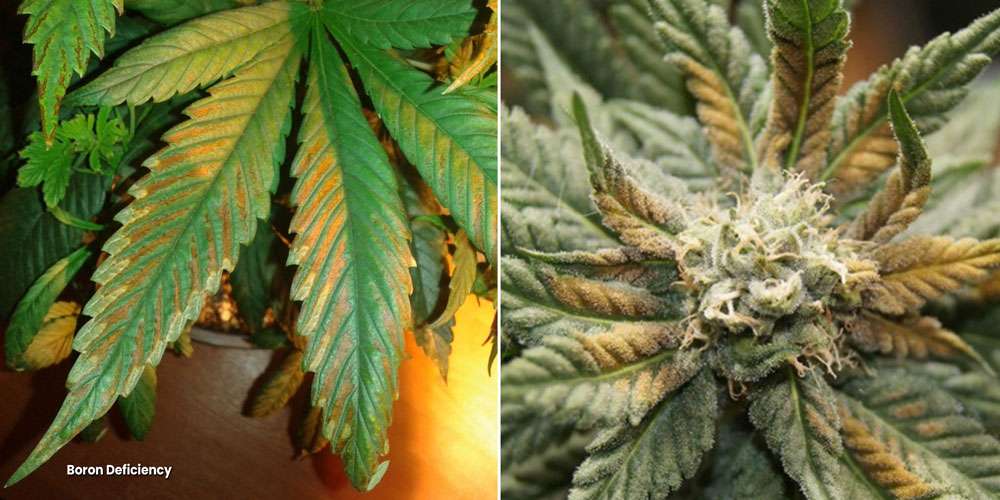
Symptoms
A lack of Boron will produce a plant that looks like it’s wilting, the technical term is lack of turgor. Vegetative growth will be poor, new growth can appear twisted. The leaves can show a yellow/brownish discoloration.
How to treat it
Flush the grow medium and add some extra Boron. This is done by adding a teaspoon of Boric acid to 3-4 liters of water and feeding it to your plant.
Copper deficiency in cannabis
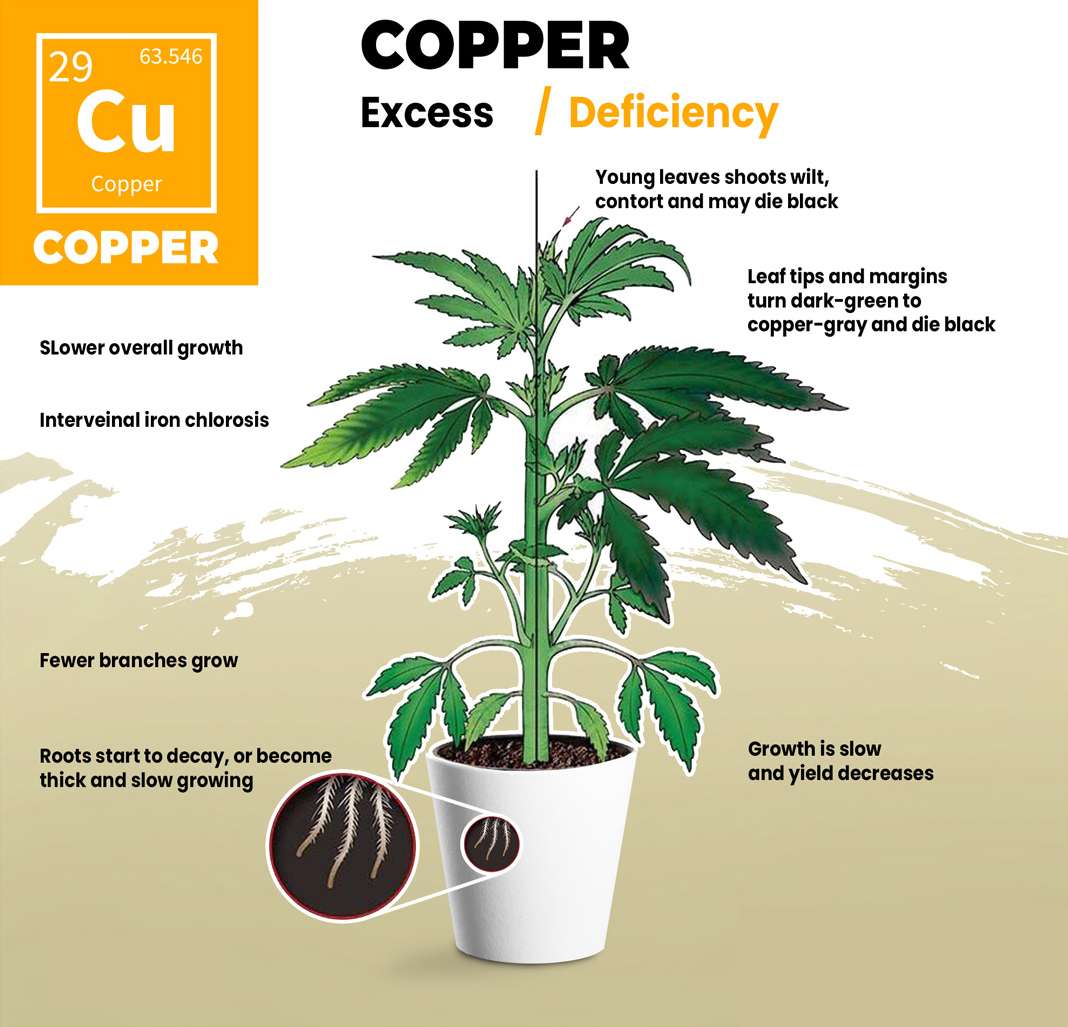
Copper (chemical symbol ‘Cu’) is a semi-mobile macronutrient. It helps the plant utilize Nitrogen and assists in the metabolism of carbohydrates. It’s unusual to see genuine cases of copper deficiency; most grow mediums and feeds have sufficient Copper for the plant requirements.
Symptoms
You will see slow wilting occurring. New growth can appear to twist and turn as it grows.
How to treat it
Treating deficiencies of mobile macronutrients such as Nitrogen, Phosphorus and Potassium are more straightforward than treating more complicated deficiencies involving micronutrients of heavier metals such as Molybdenum, Iron, and Copper, etc. Getting the correct dosing required, and the correct form of the mineral isn’t easy.
Who wants to be dosing their cannabis plants with heavy metals when they plan to be smoking the weed a few weeks later? Prevention of these deficiencies is the only real way to go.
Iron deficiency in cannabis
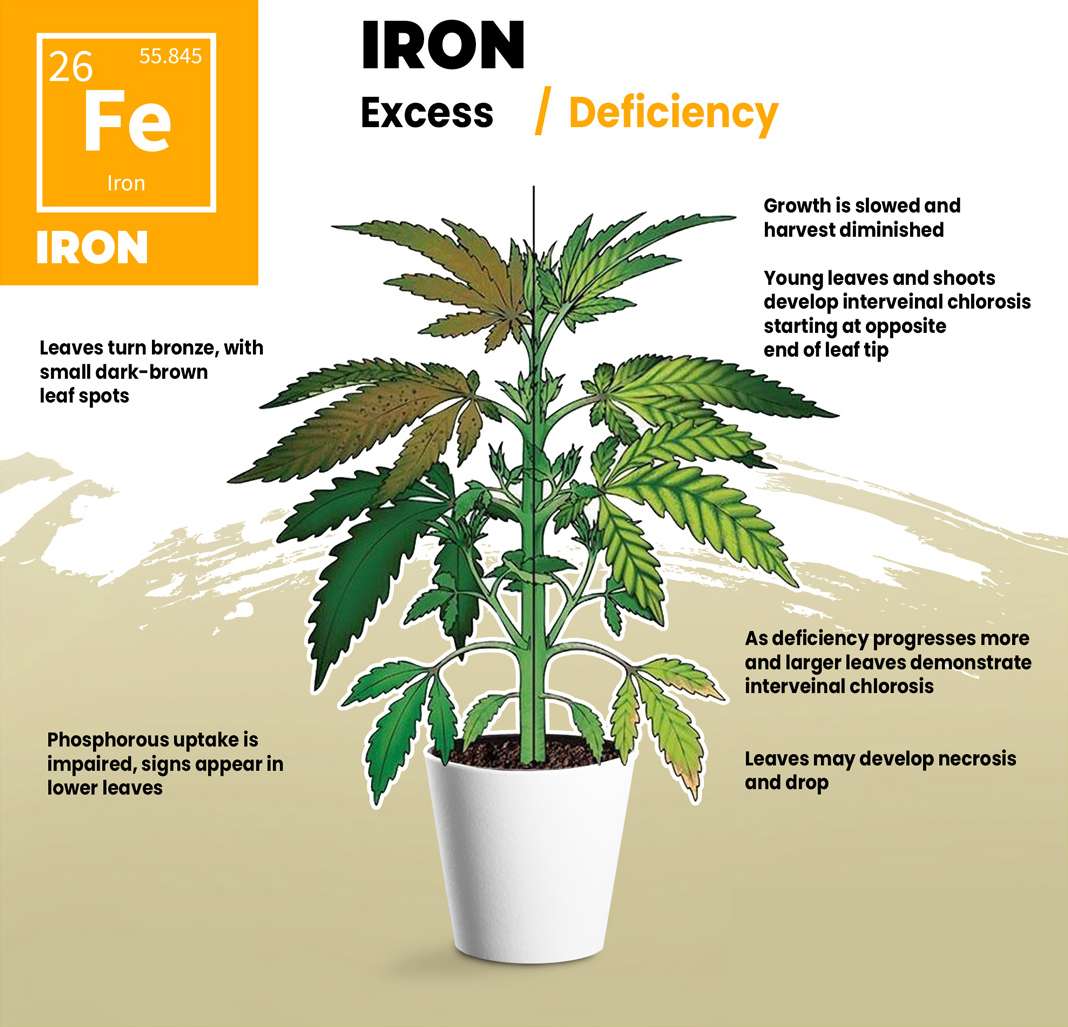
Iron (chemical symbol ‘Fe’) is a semi-mobile macronutrient. It is necessary for the use of nitrates (Nitrogen-containing) and sulfate (Sulphur-containing) compounds. Iron is also required for the production of chlorophyll. Iron deficiencies can occur if pH is out of range. Excess Zinc, Manganese, or Copper can also cause it. All of these can interfere with iron uptake. Iron is an important mineral for general metabolic and energy-forming processes.
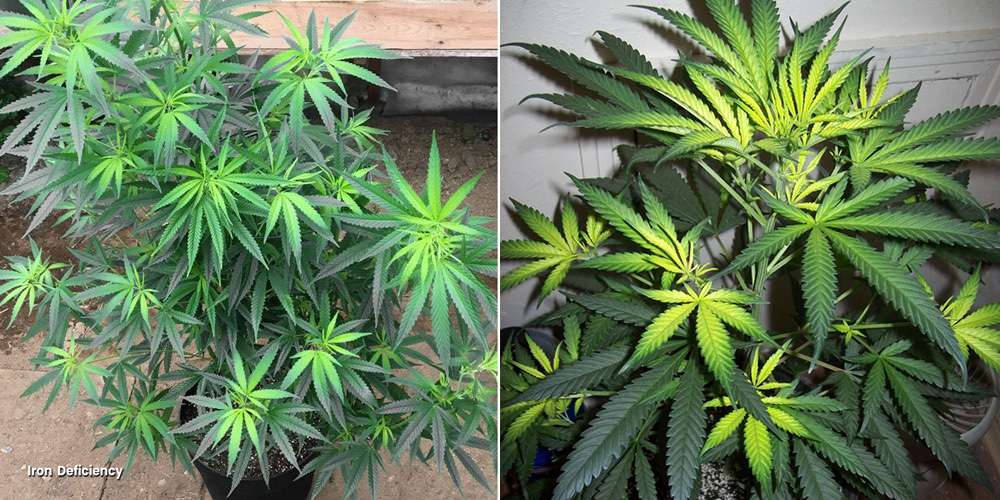
Symptoms
Symptoms of Iron deficiency can initially appear in new plant growth. Interveinal chlorosis can appear at the base of new leaves. After this, the same symptoms can be seen through the leaves and older growth. Overall yellowing between the leaf veins is a good indicator of Iron deficiency.
Manganese deficiency in cannabis
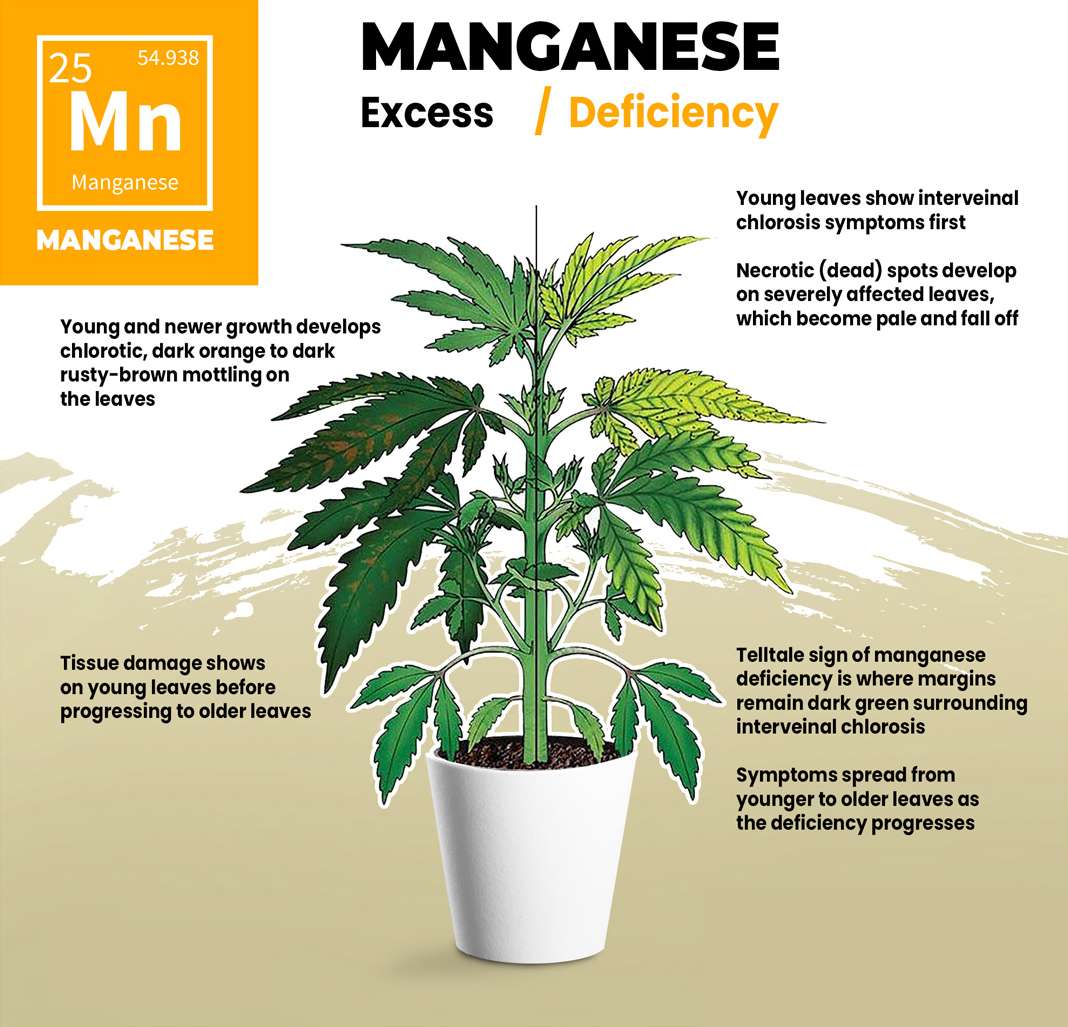
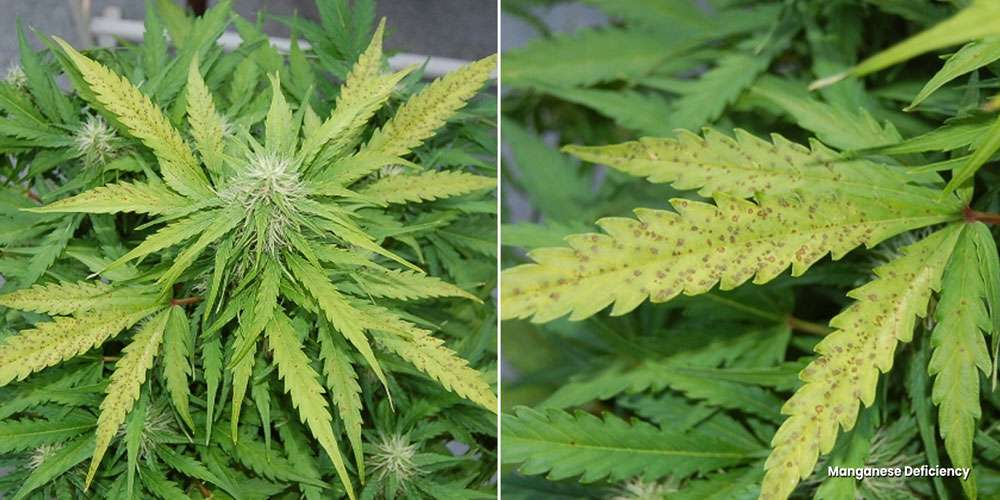
Manganese (‘Mn’) is an immobile micronutrient. It helps with several important cell functions including nitrogen use, respiration, and photosynthesis. Root cell growth is aided by Manganese, which also protects roots from less useful/bad microbes. It’s unusual to see genuine cases of Manganese deficiency. Often it is related to excess Iron or high pH.
Symptoms
Just like other immobile nutrient deficiencies, Manganese deficiency tends to show up as pale discoloration (chlorosis) near the base of new plant growth. This can eventually spread out to affect the tips of leaves and brown (necrotic) spots start to appear, eventually on older leaves. The leaf margins and veins can appear green while the interveinal areas can start to yellow.
Molybdenum deficiency in cannabis
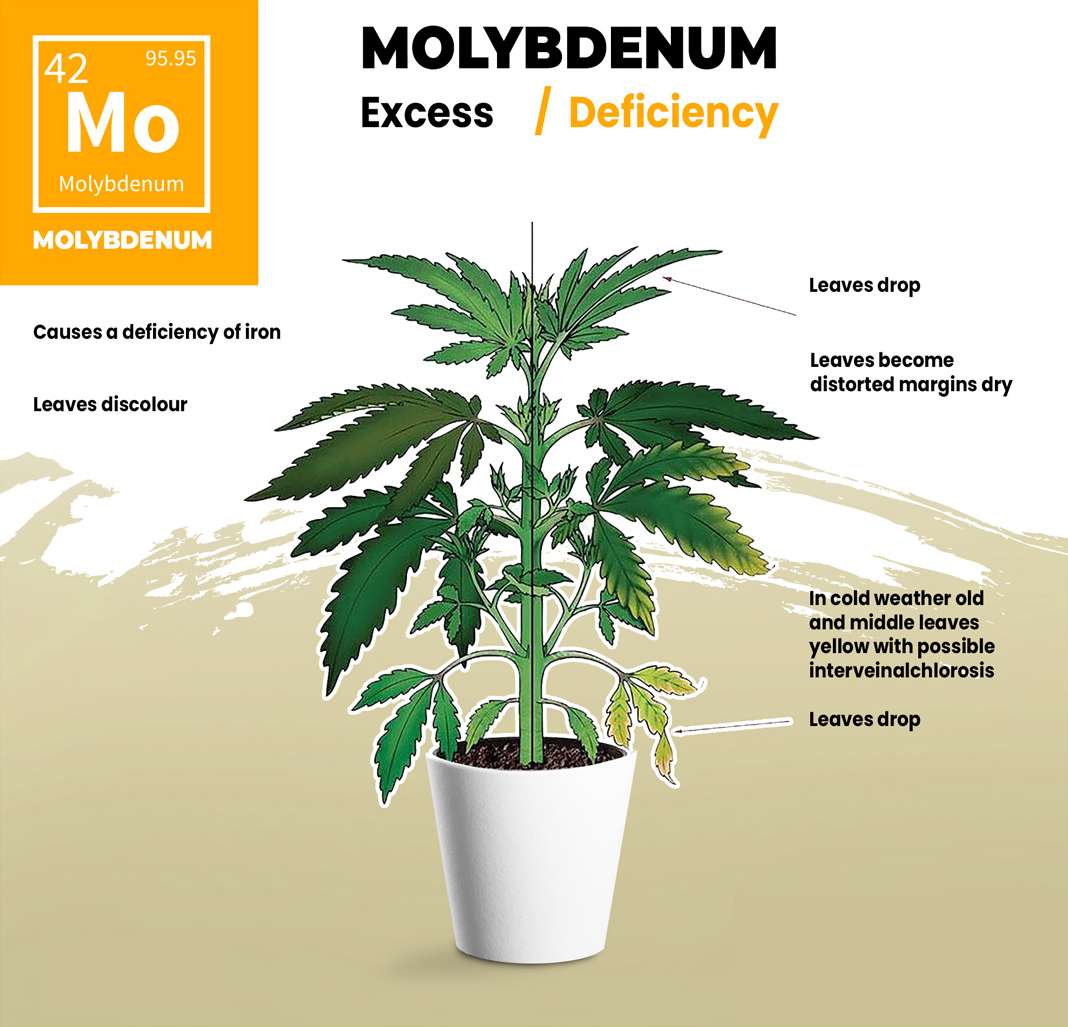
Molybdenum (chemical symbol ‘Mo’) is a mobile micronutrient. It is essential for the correct function of two important enzyme systems which convert nitrates to ammonium compounds (for the amino acid formation and subsequent plant protein production). Again, genuine deficiencies are rare and difficult to correct.
Symptoms
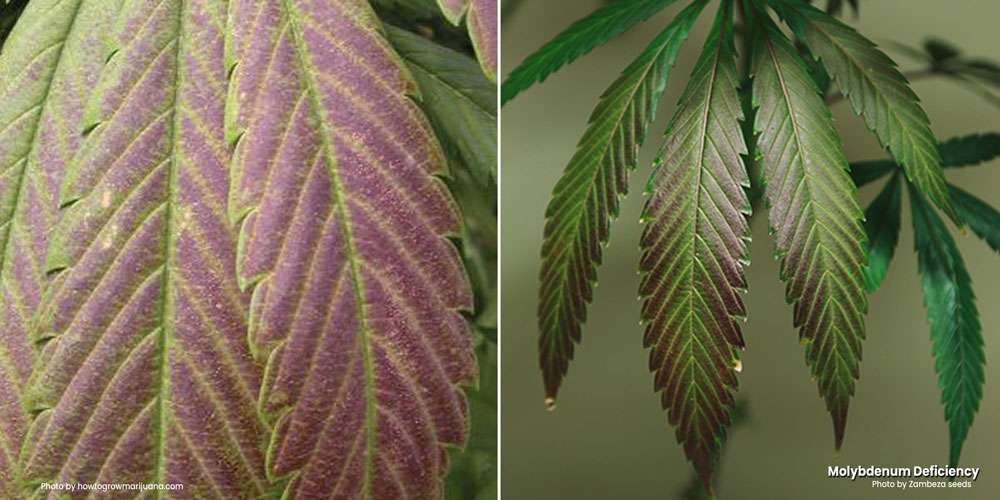
Genuine deficiencies are scarce, and they can be exacerbated by cold weather. You may see a yellowing of older leaves, which may also show interveinal chlorosis. The leaves may ‘cup’ and curl upwards before twisting and dying.
Silicon deficiency in cannabis
Silicon is an immobile micronutrient that has attracted much attention in recent years. Genuine cases of Silicon deficiency are uncommon. It’s a mineral that strengthens cellular walls, allowing sturdy growth and strong plants.
Specialist liquid Silicon feeds are available, though most growers use them in the hope of stronger plants rather than for trying to fix a deficiency.
Sulfur deficiency in cannabis
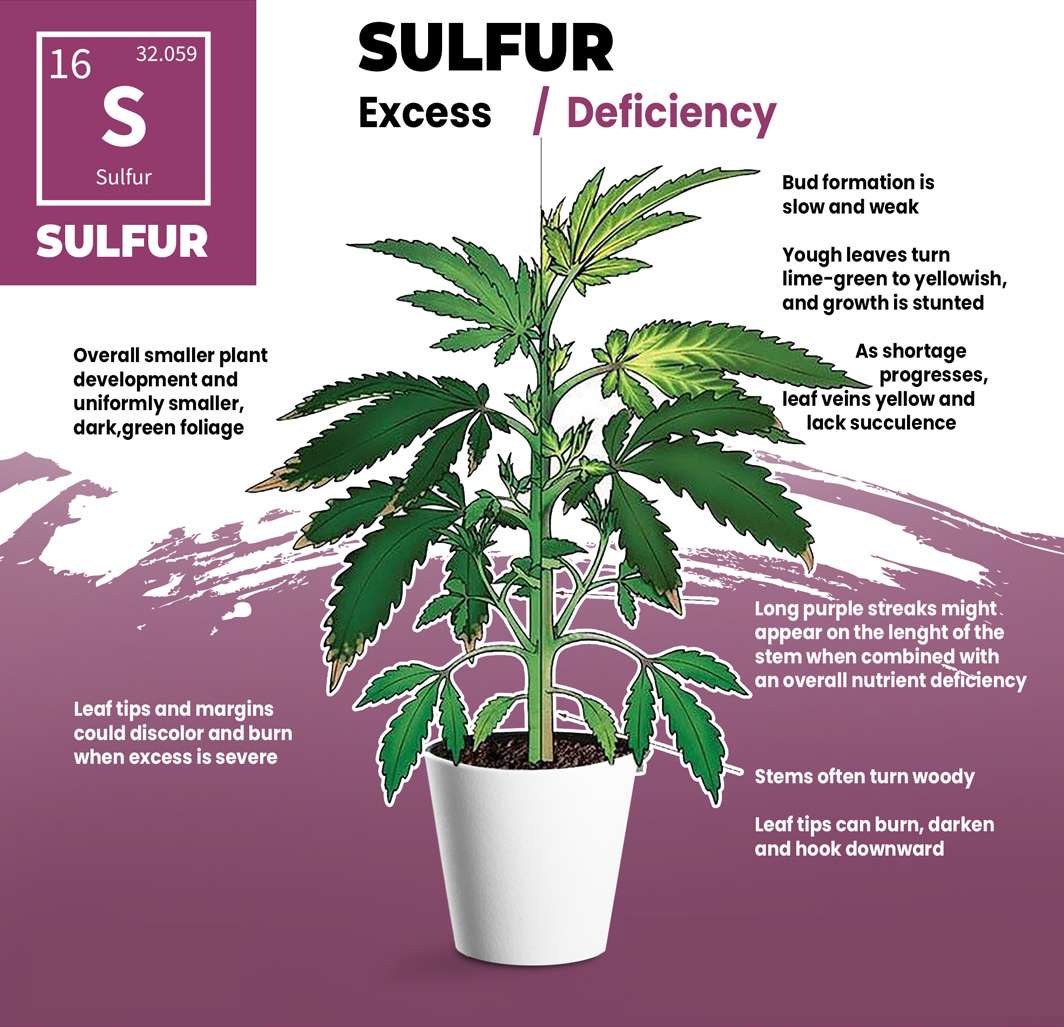
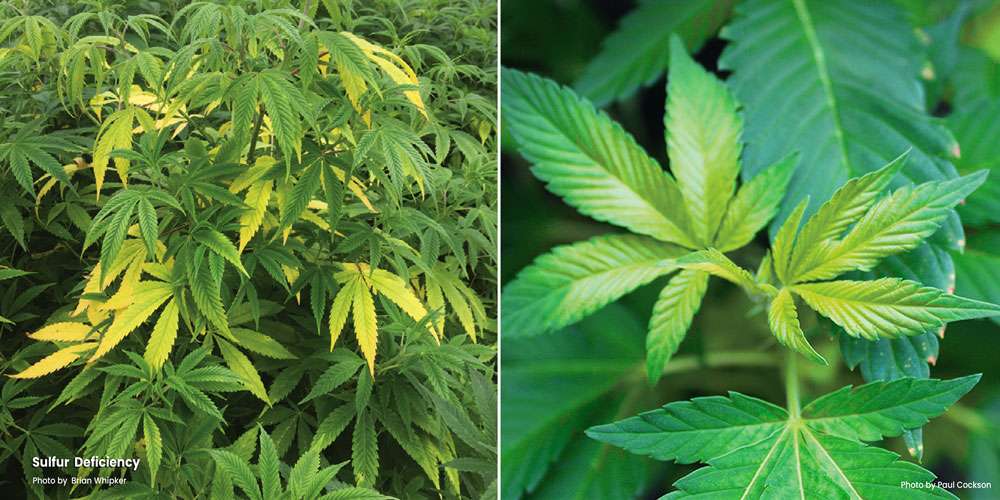
Sulfur (or Sulfur) is a critical immobile micronutrient. It’s used for vital enzymes and proteins. Sulfur is essential to plant respiration and the synthesis and breakdown of fatty acids. It also plays an important role in the synthesis of oils and terpenes. Deficiencies of Sulphur may be caused by the loss of phosphorus (due to a high pH level) in the root zone.
Symptoms
It’s uncommon to see a Sulfur deficiency, but if you have it you may see young leaves turning lime green before turning yellow. You may observe stunted growth followed by the gradual yellowing of leaf veins. The leaves may also be dry and brittle—continued deficiency results in lowered potency and inferior yields.
Zinc Deficiency in Cannabis
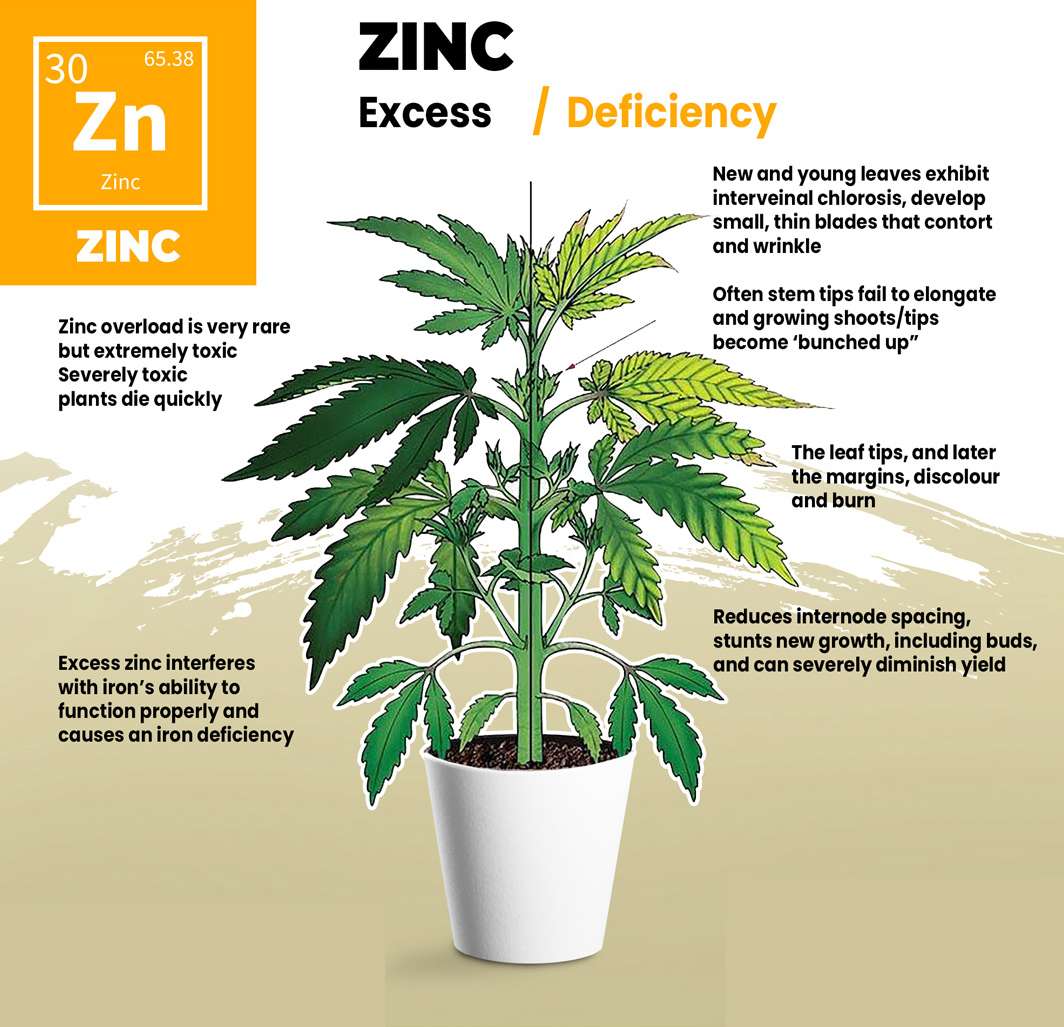
Zinc (chemical symbol Zn) is a metallic immobile micronutrient. It’s important for the production of sugar and protein. Zinc is also used to make chlorophyll and for healthy stem growth. Deficiencies can be seen, especially where alkaline soils and dry climates are present. It may also be the result of acidic pH levels. Zinc is only required in small quantities, but it is vital for forming cell membranes, proteins, and plant growth hormones.
Symptoms
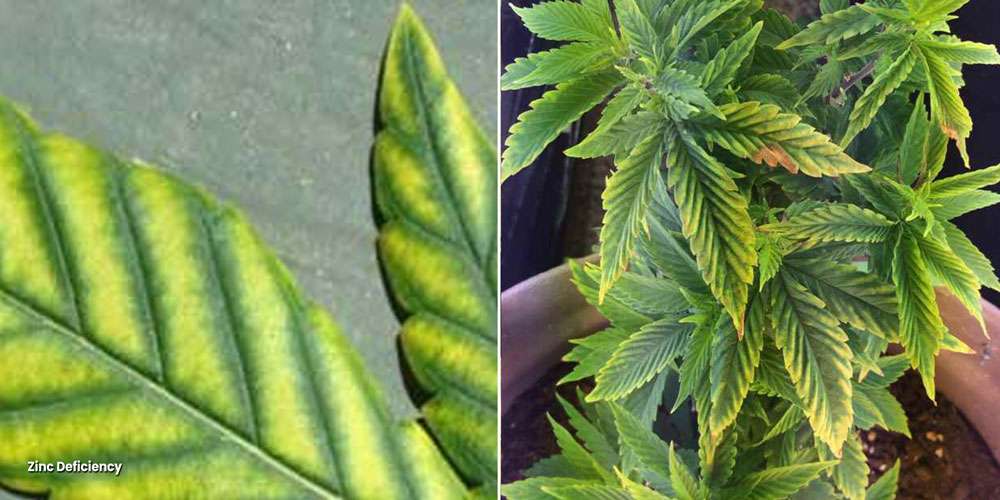
The most common signs of zinc deficiencies are new leaves and new plant growth, which tend to show inter-veinal chlorosis. The blades of the cannabis leaf may look wrinkled, yellow, and distorted. The leaf tips will discolor (yellow) and may show a brown burn at the tips. The leaves may rotate 90º sideways.
Diagnosing common cannabis plant problems
Plant health issues can be tricky to spot. Many problems show up as yellow leaves. If you guess wrong, your plant might not get better.
Too much water and cold can also turn leaves yellow. This might look like a nutrient problem.
Good growers prepare well. They use the right soil and nutrients.
Using bigger pots can help with nutrient issues. A 20-liter pot gives roots more room. This means less chance of nutrient problems. Slow-release nutrients like BioTabs are also great for keeping soil healthy.
Hydroponic systems need fresh nutrients often. This keeps the solution balanced.
How to keep cannabis plants healthy – prevent nutrient deficiencies.
Mastering nutrient management is key. Find a growing method that works for you. Understand how your plant uses nutrients.
Growing cannabis is easy and flexible. It does well indoors, outdoors, or in greenhouses. Good results come from using quality nutrients. Local shops offer expert advice.
Cannabis Nutrient Deficiencies FAQs
u003cstrongu003eWhy does nutrient deficiency get worse after feeding cannabis?u003c/strongu003e
Nutrient deficiencies can paradoxically worsen after feeding due to a phenomenon called u003cstrongu003enutrient lockoutu003c/strongu003e. When you add more nutrients to an already imbalanced growing medium, the plants can’t absorb them, causing excess nutrients to build up. This creates a snowball effect where more nutrients actually make the problem worse.u003cbru003eThe most common causes include:u003cbru003eu003cstrongu003epH imbalanceu003c/strongu003e: If the pH is too high or too low, nutrients become chemically unavailable even though they’re present in the soil. Adding more nutrients without fixing the pH compounds the problem u003ca href=u0022https://www.cannabisbusinesstimes.com/nutrition-plant-health/nutrient-knowledge-sponsored-by-advanced-nutrients/news/15702180/how-to-spot-a-nutrient-deficiency-in-your-cannabis-plantu0022 target=u0022_blanku0022 rel=u0022noreferrer noopener nofollowu0022u003eCannabis Business Timesu003c/au003eu003cbru003eu003cstrongu003eMisdiagnosisu003c/strongu003e: Growers often mistake other issues (overwatering, disease, light stress) for nutrient deficiency. Adding nutrients when the real problem is environmental makes things worse u003ca href=u0022https://bio365.com/debunking-the-myth-that-plants-showing-symptoms-of-nutrient-deficiency-always-need-more-nutrients/u0022 target=u0022_blanku0022 rel=u0022noreferrer noopener nofollowu0022u003eBio365u003c/au003eu003cbru003eu003cstrongu003eSalt buildupu003c/strongu003e: Synthetic nutrients can accumulate as mineral salts in the growing medium, blocking nutrient uptake and creating toxic conditionsu003cbru003eu003cstrongu003eSolutionu003c/strongu003e: Always check and adjust pH before adding nutrients. If deficiency symptoms persist after feeding, flush the medium with pH-balanced water to reset the root zone.
u003cstrongu003eWhy do autoflowers get nutrient deficiencies in week 3-5 of flower?u003c/strongu003e
Autoflowers are particularly prone to deficiencies during weeks 3-5 of flowering due to their unique growth characteristics:u003cbru003eu003cstrongu003eRapid transition demandsu003c/strongu003e: Autoflowers switch from vegetative to flowering stage automatically and quickly. During weeks 3-5, they’re undergoing the most intense bud development, which creates enormous nutrient demands. The plant is simultaneously:u003cbru003eStretching and expanding structureu003cbru003eForming flower sitesu003cbru003eBuilding resin production systemsu003cbru003eu003cstrongu003eHigh metabolic rateu003c/strongu003e: The leaves directly under the lights and supporting the biggest buds work overtime during this period. These u0022hardworking leavesu0022 can turn pale or yellow as the plant redistributes nutrients to bud sitesu003cbru003eu003cstrongu003eCommon deficiencies during this stageu003c/strongu003e:u003cbru003eu003cstrongu003eNitrogen deficiencyu003c/strongu003e: Lower leaves turn yellow and fall off as the plant redirects nitrogen to flowersu003cbru003eu003cstrongu003ePhosphorus deficiencyu003c/strongu003e: Critical for bud development; shows as red/purple stems and dark leavesu003cbru003eu003cstrongu003eCalcium/Magnesiumu003c/strongu003e: Spots and discoloration on newer growthu003cbru003eu003cstrongu003eWhy autoflowers specificallyu003c/strongu003e: Unlike photoperiod plants that you can keep in vegetative growth until they’re robust, autoflowers flower on a fixed timeline regardless of plant size. If they didn’t get optimal nutrition early on, they can’t u0022catch upu0022 before the demanding flowering phase begins.u003cbru003eu003cstrongu003ePreventionu003c/strongu003e: Start with appropriately amended soil or begin feeding bloom nutrients by week 2-3, increase gradually, and watch for pale leaves or yellowing as early warning signs.
u003cstrongu003eDo organic nutrients fix cannabis deficiencies slower than synthetic?u003c/strongu003e
u003cstrongu003eYesu003c/strongu003e, organic nutrients typically correct deficiencies more slowly than synthetic nutrients:u003cbru003eu003cstrongu003eOrganic nutrientsu003c/strongu003e:u003cbru003eu003cstrongu003e2-3 weeks for full recoveryu003c/strongu003e – Organic amendments must be broken down by soil microbes before plants can absorb themu003cbru003eu003cstrongu003eSlower nutrient releaseu003c/strongu003e – Natural decomposition processes take timeu003cbru003eu003cstrongu003eBetter for preventionu003c/strongu003e – Top-dressing with amendments like compost or dolomite lime works well as preventative care but won’t provide quick fixesu003cbru003eu003cstrongu003eExceptionu003c/strongu003e: Liquid organic nutrients and compost teas can provide faster results than dry amendments, but still slower than syntheticsu003cbru003eu003cstrongu003eSynthetic nutrientsu003c/strongu003e:u003cbru003eu003cstrongu003e3-7 days for visible improvementu003c/strongu003e – Synthetic nutrients are immediately available in forms plants can absorbu003cbru003eu003cstrongu003eSuperior for emergency correctionu003c/strongu003e – When you need to fix a deficiency quickly, synthetic nutrients are the clear choiceu003cbru003eu003cstrongu003ePrecise controlu003c/strongu003e – You can adjust nutrient levels and see results within daysu003cbru003eu003cstrongu003eQuote from researchu003c/strongu003e: u0022While organic teas can provide a quicker nutrient boost, they typically take longer to correct deficiencies than synthetic alternativesu0022 u003ca href=u0022https://www.dirtconnections.com/is-soil-organic-or-synthetic-nutrients-best-for-your-cannabis-plant/u0022 target=u0022_blanku0022 rel=u0022noreferrer noopener nofollowu0022u003eDirt Connectionsu003c/au003eu003cbru003eu003cstrongu003eBest practiceu003c/strongu003e: Use organic nutrients for maintenance and base nutrition, but keep synthetic nutrients on hand for emergency deficiency correction during critical flowering phases.
u003cstrongu003eShould I add more nutrients or flush when my cannabis has nutrient problems?u003c/strongu003e
This is the most critical decision in nutrient management, and the wrong choice can destroy your crop:u003cbru003eu003cstrongu003eFlush when you see these signs (nutrient lockout)u003c/strongu003e:u003cbru003eDeficiency symptoms appear despite regular feedingu003cbru003eMultiple different deficiencies appearing simultaneouslyu003cbru003eDark green leaves with burned tips (nutrient burn)u003cbru003eSymptoms worsen after feedingu003cbru003epH is off despite adjustmentu003cbru003eSlow growth despite adequate nutrientsu003cbru003eu003cstrongu003eHow to flushu003c/strongu003e:u003cbru003eStop feeding immediatelyu003cbru003eRun pH-balanced water (6.0-7.0 for soil, 5.5-6.5 for hydro/coco) through the medium until 30% runoffu003cbru003eWait 30 minutes, then repeatu003cbru003eAllow medium to dry before resuming feeding at reduced strengthu003cbru003eRecovery typically takes 7-10 days u003ca href=u0022https://atami.com/usa/blog/cultivation/cannabis-nutrient-lockout-guideu0022 target=u0022_blanku0022 rel=u0022noreferrer noopener nofollowu0022u003eAtamiu003c/au003eu003cbru003eu003cstrongu003eAdd nutrients when you see these signs (genuine deficiency)u003c/strongu003e:u003cbru003ePale, lime-green leaves throughout the plantu003cbru003eLower leaves yellowing and falling off easilyu003cbru003eSymptoms appear on biggest bud sites firstu003cbru003epH is correct (tested and adjusted)u003cbru003eNo signs of nutrient burnu003cbru003ePale color under grow lightsu003cbru003eu003cstrongu003eThe golden ruleu003c/strongu003e: u0022Check your pH before adding ANYTHING to your grow. It’s almost always pH lockout rather than an actual deficiencyu0022 u003ca href=u0022https://www.reddit.com/r/microgrowery/comments/rsx5bt/here_is_a_great_chart_for_identifying_deficiency/u0022 target=u0022_blanku0022 rel=u0022noreferrer noopeneru0022u003eReddit r/microgroweryu003c/au003eu003cbru003eu003cstrongu003eDecision treeu003c/strongu003e:u003cbru003eTest pH first – if wrong, flush and adjustu003cbru003eIf pH is correct but plants look hungry (pale/yellow), add nutrientsu003cbru003eIf pH is correct and leaves are dark green with problems, flushu003cbru003eWhen in doubt, flush – it’s safer than overfeeding
u003cstrongu003eCan RO water cause nutrient deficiency in cannabis?u003c/strongu003e
u003cstrongu003eYesu003c/strongu003e, reverse osmosis (RO) water can absolutely cause nutrient deficiencies if used improperly:u003cbru003eu003cstrongu003eWhy RO water causes problemsu003c/strongu003e:u003cbru003eu003cstrongu003eStrips essential mineralsu003c/strongu003e: The filtration process removes not just contaminants but also beneficial calcium and magnesium that plants needu003cbru003eu003cstrongu003eZero PPM = zero mineralsu003c/strongu003e: RO water starts at 0 PPM with no buffering capacityu003cbru003eu003cstrongu003eLower natural pHu003c/strongu003e: RO water is naturally more acidic (around 5.5-6.0), which can cause certain deficiencies if not adjustedu003cbru003eu003cstrongu003eMost common deficiencies from RO wateru003c/strongu003e:u003cbru003eu003cstrongu003eCalcium deficiencyu003c/strongu003e: Brown spots, weak stemsu003cbru003eu003cstrongu003eMagnesium deficiencyu003c/strongu003e: Yellowing between leaf veinsu003cbru003eu003cstrongu003eTrace mineral deficienciesu003c/strongu003e: Various symptoms depending on what’s missingu003cbru003eu003cstrongu003eQuoteu003c/strongu003e: u0022But before you start showering your cannabis with RO water, there’s a catch. The filtration process doesn’t just remove harmful contaminants — it also wipes out essential nutrients like magnesium and calciumu0022 u003ca href=u0022https://growdiaries.com/journal/your-guide-to-growing-cannabis-with-ro-wateru0022 target=u0022_blanku0022 rel=u0022noreferrer noopener nofollowu0022u003eGrowDiariesu003c/au003eu003cbru003eu003cstrongu003eHow to use RO water correctlyu003c/strongu003e:u003cbru003eu003cstrongu003eAdd Cal-Mag supplementu003c/strongu003e – Essential for every feeding (150-200 PPM of Cal-Mag before other nutrients)u003cbru003eu003cstrongu003eRemineralize the wateru003c/strongu003e – Add trace minerals or use mineral dropsu003cbru003eu003cstrongu003epH adjustmentu003c/strongu003e – Always test and adjust pH after adding nutrientsu003cbru003eu003cstrongu003eMonitor EC/PPMu003c/strongu003e – Start with base minerals before adding grow nutrientsu003cbru003eu003cstrongu003eWhen RO water is beneficialu003c/strongu003e:u003cbru003eYour tap water has high PPM (u003e400) or contaminantsu003cbru003eYou need precise control over nutrient contentu003cbru003eGrowing hydroponically where you control all inputsu003cbru003eu003cstrongu003eAlternatives to ROu003c/strongu003e:u003cbru003eu003cstrongu003eBottled spring wateru003c/strongu003e: Contains natural minerals, typically 40-100 PPM, usually pH balanced around 6.8-7.0u003cbru003eu003cstrongu003eFiltered tap wateru003c/strongu003e: If your tap water is decent quality (100-200 PPM), a simple carbon filter removes chlorine while keeping mineralsu003cbru003eu003cstrongu003eSpecial warning for organic growersu003c/strongu003e: u0022RO water and living soil do not mixu0022 – the beneficial microbes in living soil need minerals from water to thrive. Using pure RO water can harm your soil biology
Original research and images by Dutch Passion.